Tuesday, September 21, 2010

Africa: termites?

As I traveled around Kenya and Tanzania I have seen a wide variety of termite nests. In the tropics, termites are the largest animal biomass and it shows. In some locations termite mounds (nests) are spaced about every 20 feet and are 3-5 feet high and 10 feet in diameter. Sometimes they are just mounds, some times they have multiple towers giving them the appearance of a castle, and here near Lake Baringo, they produce chimneys over 10 feet tall (see photos).
The termite mounds vary in color depending on the local soil. I've see light brown, dark brown, grey, red, and tan mounds.
Although most termite mounds have been on the ground, some termites carry mud up trees and build their mounds around branches, or around tree trunks. These are not as large as the ground mounds, often only a bit bigger than a basketball. Some termites in Kagamega Forest build nests that were attached to the side of a tree trunk, and just looked lie the weight would have pulled the colony down.
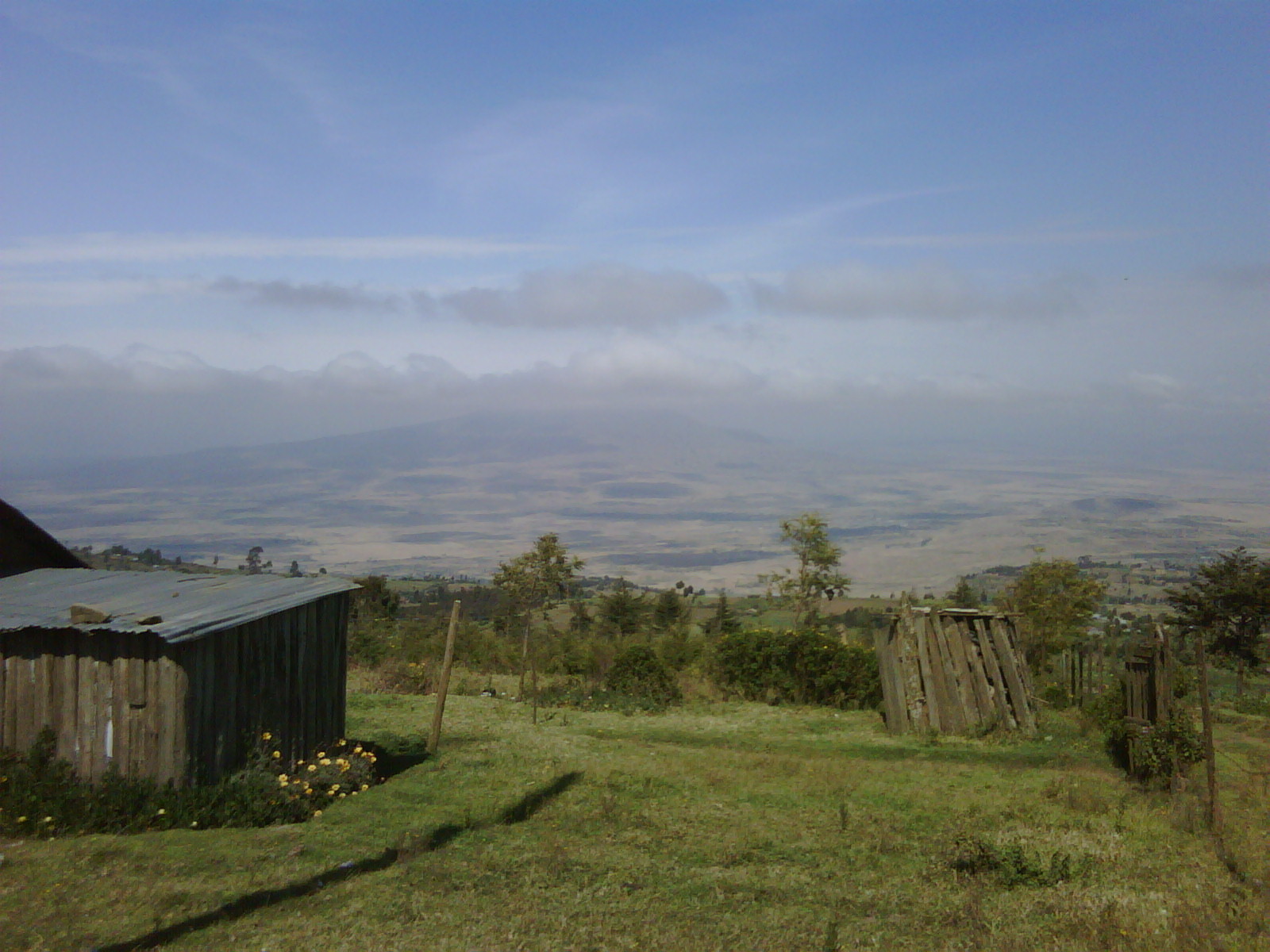
Also attached is a photo of Jackson's Hornbill that flew into the vines next to our table during lunch. And a dramatic view of cliffs formed as the Great Rift Valley floor sunk. Near Baringo the rift cliffs form three massive steps from the rim down to the valley floor.

Africa: Hornbills!

As anyone knows who has seen the Lion King, Hornbills are large black and white birds with very big bills. So I was looking forward to seeing one in its natural habitat. There are actually 20 species of hornbills in East Africa, differing in bill color and overall coloration. However, only 10 are found in the parts of Kenya and Tanzania that I have visited.
Amazingly, as of today, I've seen 9 different Hornbills! Including 4 different species this morning.
In the dry scrub lands I've seen Yellow-billed and Red-billed Hornbills; in the more woodland areas I've seen Grey Hornbills. A particular weird one, the Ground Hornbill, which has a massive black bill and red face, feeds on the ground and is huge: over 3 feet high. It acts more like a turkey than a hornbill.
But one of the highlights of Africa was seeing the Black-and-white casqued Hornbills. This moist forest bird has a huge extension or casque on its bill. Its large 3 foot wings are half black and half white, which when it flies makes a whirring sound like a jet engine. Finally it has a very loud and raucous call. Overall it is unmistakable. They seem to be doing well, after dawn while waiting for breakfast at the Rondo Retreat in Kagamega forest, I counted 132 fly over the lodge, each one calling and sounding like a plane!

Monday, September 20, 2010

Africa: Day 15

At Kakamega Forest, we had a good chance to watch 3 species of monkeys travel through the canopy. The Blue Monkeys seem the most energetic moving rapidly from tree to tree. The Copper Tailed monkeys moved more slowly, making shorter jumps. The most beautiful of the monkeys were the Black and White Colobus monkeys. They were the largest and made some of the longest leaps.
The most interesting Black and White Colobus I saw was sitting at the very top of a tall tree, one leg crossed over the other at the knee, motionless and apparently very pensive. He seemed to be contemplating the biggest questions of monkey life.
Today we left the wet, cool Western Kenyan forests (elevation 6200 feet) and drove down into the Great Rift valley to Lake Baringo. Since the lake elevation is only 3000 ft, it is hot, dry scrub country. This will be our hottest location with afternoon temperatures well into the 90's.
We made a few short birding stops, and reached the Lake Baringo Club in the afternoon, where we had time to check out the bird life around the lodge. The 20 new species seen today pushed the trip total to an amazing 412 and our mammal total has reached 44!

Pictures from Nakura NP

I have a good connection today so here are photos of Flamingos, a Waterbuck, 2 white rhinos, baboons, and some impala.

Saturday, September 18, 2010

Africa: Day 13: The Forest

Yesterday was mostly spent traveling, first to the northeast corner of Lake Victoria, which is the second largest fresh water lake in the world and the source of the Nile. It is also the western border of Kenya and Uganda. The lake shore is mostly lined with towns and villages, but we reached the lake shore at a small conservation area. However, our stay was short as a strong thunderstorm boiled in off the lake.
Late in the day we reached Kakamega Forest Reserve. A relatively small remnant of the forest that once filled the Western Highlands. All the rest has been cut down for small farms or vast tea estates.

Tea is still Kenya's largest export, and individual estates (or farms) can extend for 10's of miles and employ over 10,000 workers on a single estate. Each section of tea is picked every 14 days, only the last 2 leaves of each stem are picked, all by hand. We stopped at an estate for a picnic lunch, the tea bushes were about 3.5 feet high, to minimize bending over when the leaves are picked.

There are no large predators in the forest preserve so unlike our visits to the national parks, we don't have to stay in our van. So today we walked along the forest dirt roads and trails looking for birds, It was the best day for new birds in a week and I saw 38 new birds, even though we cut the afternoon short because of rain. Most days, even in the dry Serengeti we've had short afternoon rains (15 min to an 1 hour), but today the rain came at 4 and continued until dark (about 6:30). So we returned to our lodge.

The lodge is an interesting place, its actually a retreat for Baptist ministers who get stressed out working in Africa. But the take tourists to pay for the cost of the retreat. It has a beautiful gardens and grounds, a lovely trail along a small
creek, and is the only lodging in the forest.

Although there are no predators or grazing wildlife around, we did see 3 species of monkeys, including a really pretty black and white monkey called the Black and White Colobus.

There were several pretty amazing birding highlights today. I will describe just three. First I saw an African Emerald Cuckoo. This bird is a brilliant emerald green back, head, and neck, then a stunning yellow breast, truly beautiful. Second while walking on the road, two African Grey Parrot flew over, since only 9 are known to be left in Kenya, this was a very lucky rare sighting. The third sighting was of an African Crowned Hawk-Eagle. This is the second largest eagle in East Africa, and the most powerful. It has been observed killing a 300 lb Eland, and seen carrying a 40 lb dog. In Kakamega Forest, the Hawk-Eagle hunts monkeys, so when we heard loud screeching from nearby monkeys we looked up and were fortunate to see an African Crowned Hawk-Eagle flying just below the canopy and then land in a tree close to us. Allowing us close views through the spotting scope at this large (3-foot long), uncommon and rarely seen beyond a glimpse, raptor.

Friday, September 17, 2010

Africa Days 10 and 11

Sep. 15 was a long travel day from Tarangarie NP to Nairobi, the road was under construction so we were frequently traveling on dusty dirt detours. Since we had already birded on the way west we made very few stops. This is a very dry area of Tanzania and Kenya, and over grazing by the local tribes people is very evident. This is an area where many people still live the Masai herding culture. But occasionally I saw a traditionally blanket-dressed Masai teenager talking to another teen in jeans and T-shirt. Another time I saw a young Masai herder, tending cattle as has been done for 100's of years, but also talking on his cell phone. So times are changing.
Most of the people here are, of course poor, but there was not any sense of people going hungry or any evidence of intense begging.
We also traveled through Arusha, a bustling city of about 1 million. Here well dressed middle class men and women intermix with traditional tribes people and the young in their jeans and T-shirt/sweatshirt. Huge numbers of 14 passenger vans dart in and out of traffic to pick folks and take them a few miles or to outlying villages.
Although it was a hazy day and somewhat cloudy. North of Arusha we saw my first glimpse of Kilimanjaro! All I could see was the west flank, which had substantial snow visible. The rest of the mountain was lost in the clouds.
With the long drive Sep 15, I only saw 1 new trip bird among the 63 different species we saw. Today I saw 21 new species among the 94 specie seen.
We limited our stops so we would reach Nairobi before rush hour. Nairobi is a hub for manufacturing and assembly of things for Africa, it has the feel of a city growing very fast. Nairobi numbers over 7 million people, and although many live in small shanty homes, huge numbers of folks are well to do middle class, as evidenced by all the locals driving their own cars. This is somewhat surprising because the Kenya government imposes an import duty of 100% (for the smallest cars) to 250% for all wheel drive/jeep like cars. Thus a car like a small Toyota will cost $30K, and a new 4 wheel jeep, which is essential in the more remote areas, can cost $150K. Traffic jams lock up the streets for hours, new buildings are being built all over the city and major new highways are being constructed to ease the flow of cars and those ubiquitous 14 seat vans.
Pedestrians are everywhere, filling the sidewalks, walking down the median of highways, and crossing roads randomly and not at crosswalks. People will suddenly cross anywhere not just city streets but even 4 lane highways, with apparent reckless abandon.
Thursday we left Nairobi and headed north and west to Lake Nakuru, a vast alkaline lake in the great Rift Valley. As we left Nairobi, climbing from 5000 to 8000 feet the land got wetter and cooler. For the first time we saw green crops of corn, sugar cane, and other vegetables. Every bit of level ground seemed to be used for crops or grazing.
After a few hours of driving, with a few stops for birding, we reached the edge ofd the Rift Valley and looked down 2000 feet to rift valley floo,r or across 12 to 20 miles to the other side. This rift is continuing to grow wider and deeper as East Africa, from Djibuti to Tanzania, moves east while the rest of Africa remains stationery.

Wednesday, September 15, 2010

Photos from Africa

Near Arusha with good connection so here are a few photos

Africa Day 9: Lion kill

After the day's wildlife viewing I went to the end of the tents at a river overlook. I went to get a clear view of the western horizon because I thought there would be good sunset. As I stood at the point I noticed a herd of wildebeest stampeding up river, as I looked down I saw that a lion had pulled down a young wildebeest and the lion had it by the neck. The wildebeest thrashed for a few minutes then died from the lion's crushing its throat. After awhile the lion dragged the kill to the side of the river, presumably to eat.

Tuesday, September 14, 2010

Africa Day 10

Started the day watching 2 lions walk upstream. After breakfast I spotted a skunk-like animal down in the valley, it turned out to be a Honey Badger, apparently one of the toughest and fierest animals in Africa. Nocturnal, it is unussual to see one in the daytime.
During the morning wildlife drive we came upon several groups of elephants, because this is towards the end of the dry season they have come here because of the permanant river. It is estmated there are over 500 in the park now. We also saw our first Elan, the largest antelope.
After lunch I sat on the cliff outside our lodge, above the river valley. About 250 wildebeest, 100 zebra, and a smattering of Eland, Impala, warthogs, ostrich came to the river to drink. After getting a drink, they started to slowly move away from the river to graze on the dry grasses. Suddenly a baboon issued a loud alarm call and all the animals began running from the river. But soon they calmed down, apparently no predator was sighted, and they continued grazing.

Africa Day 8

Today was mostly a long drive from the Serengeti National Park, back past Ngorongoro Crater National Park, then south to Tarangire National Park. The drive was mainly over dirt roads and took about 8 hrs. Because Tarangire has a year round river, it attracts wildlife during the dry season, which is now.
As always when driving we make few stops to check for birds, so even though most of the day was spent driving we still saw 105 species of birds including 17 ones not yet seen. We also saw our first Common Waterbuck and large numbers of Baobab trees. The trees are thousands of years old, despite the elephants which rip up the tree trunks to get the moist inner wood. Many Baobab trees show heavy scaring from elephants.
To enhance our safari experience tonight we are staying at Tarangire Safari Lodge, a tented camp. The camp is located on the edge of cliffs that overlook the river. Staying in the cam allows the sounds of the scrub forest to be clearly heard (just heard a monkey give an alarm call.). Before dinner I was relaxing over looking the river and saw a lion walking along the sand at the water's edge.