Sunday, September 12, 2010

Africa, last day on the Serengeti

Today we drove to a visitor center and a few campgrounds where we could leave our van and look carefully for birds.

After lunch I went up on the observation deck and did a 360 scan. Looking with binoculars into the acacia scrub forest From this one spot I saw giraffe, buffalo, zebra, gazelle, baboon, hyrax, and mongoose. Such variety is typical of the Serengeti.
In the afternoon we saw the big three of cats: leopard (in a tree pretty far off), lion (two prides resting close, over 20 lions, including our first adult male), and the luckiest, a cheetah on a ridge about 300 yrds away finishing a kill.
My bird list continues to grow, another 11 new species were seen today.

Africa Day 6: L and L

The birding and wildlife tour has been focused on looking for birds, but we stop to view other wildlife we happen upon. But today we set out in the morning with a goal to find big cats. We drove through an acacia scrub forest along a stream valley, the stream still had significant water even at the end of the dry season. The stream was flanked by bright green palms and fig trees, quite a contrast to the predominantly brown, treeless grasslands of the Serengeti. In this area the grasses were 3 to 4 feet high, perfect cover for lions and leopards. Of course that makes seeing them difficult! After about 30 minutes we came to a large fig tree from which a vervet monkey was giving an alarm call. However, despite intense searching we failed to find the cause of the monkey's interest. So we continued on.
Later we passed another safari van and the driver said a leopard had been seen back up the stream. By the time we reached the very same fig tree, about 20 safari vans were lined up watching, clearly the monkey was right to give an alarm. Soon we had very nice views of a leopard coming down the tree until he disappeared into the grass. But careful searching revealed a second leopard still in the tree, lying on a limb! It is quite unusual to see two leopards together since they are solitary hunters. Turns out the first leopard was a +1 year nearly full grown cub, and the leopard in the tree was the mother, both looked healthy and well fed.
After watching for a half hour or so we again headed up the stream valley, then crossed to the other side, just as a pride of lions crossed the dirt track! At least 10 lions: 4 lionesses and 6 cubs crossed slowly and unconcerned, while the cubs pounced, jumped on the moms, and generally acted as if they were in a Nat Geo documentary. Our driver then took us up a small rise and turned right onto another track hoping we'd get another view. This time we saw the whole pride walk towards us, some coming within 3 feet of our van! We got a full count: 6 lionesses, 2 yearlings, and 8 cubs!
After the lions had disappeared into the grass we continued birding, until we returned to the lodge for lunch. Afternoon rains kept as at the lodge until about 4:00, but we went out wildlife viewing and birding until dusk. Because of the wild predators, you can not leave a vehicle, and you are not allowed out in car after dark. Although much of the day was spent looking for L and L, we still saw 79 species of birds, including 11 new ones for the trip.
As I was finishing writing this post sitting at a picnic table outside the lodge, one of the staff came over. He asked if I had seen the lions as I went back to my room last night. Apparently 2 lions were only 10 feet off the path that went from the lodge to my room, and I had passed them unaware. A fitting end to a day of leopards and lions in the Serengeti!

Saturday, September 11, 2010

Africa Day 5, part 2

Although most of the day we were driving, we still had a successful day seeing wildlife and birding. We made stops at serveral dry river beds to search for birds. In addition we made a wildlife drive around our lodge. The lodge, 4eronera, is an architectural mmarvel. It is constructed on a granite outcropping. The lodge spaces include various granit rocks as walls and other features. The lodge sits in an acacia forredt through which flow sevearl streams that stau wet year round. Hence the is a good variety of wildlifeof which we saw Topi (a large antelope) hyraxes, monkeys, mongoose, giraffe, Thompson gazelle, Impala, and Ostrich, African Buffalo.
Birding was also good, despite all the driving we saw over 100 species, 42 of which were seen for the first time on the trip.
Because the animals are wild and unafraid of people, visitors can not leave their vehicle. Since our van's top can be lifted up, we can stand in the vehicle, see 360 degrees, and get good views of wildlife, which often is quite close to the road.

Africa Day 5, part 1

Today we spent most of the day driving from Ngorongoro Crater to Serengeti National park, a long dusty drive over dirt roads. The drive helps bring home the vastness of East Africa. The landscape changed from dry forest to scrub forest to the vast grasslands of the serengeti, which means endless grass. To break up the drive we made several stops, and not just for birds. We stopped at a Masai village and were hosted by one of the chief's son on a tour, the chief has 42 children by is 10 wives. All the houses in a village are made by the women, a 2 day project in which sticks 1 to 3 inches in dimeter arewoven into a wall with flexible small braances. The 20 foot diameter house walls and roof are covered with cow dung to seal them. Inside is a central cooking area surrounded by 4 sleeping chambers: one for the mother, one for the father if he visits, on for the children, and one for any small goats or calfs.
The Masai have well defined roles, women make houses, cook, and tend to young children. Young boys tend livestock, and young men become warriors to defend the village and lifestock. Previously, young boys became warriors by killing a lion, earning them the right to wear red blankets. Because the population of lions has declined and the population of Masai has increased, now they become warriers by chasing off a lion. Their culture revolves around livestock, a bride's family must be compensated with cows, a man's riches are defined by the number of cattle, goats, or donkeys he owns. Except for some millet, they eat meat, milk, and blood.
We also made a stop at Oldupia Gorge, (it was miss translated as Olduvia Gorge by a german researcher) a 25 mile grorge where the Leaky's did research and helped define the hominid evolutionary tree from .5 to 4.0 million years ago. Although now a dry scrub river valley, the area was once wet and lush. 10,000's of stone tools and fossil remains have been found, including two stunning fossil tracks showing that early hominids walked upright over 1.5 million years ago.

Thursday, September 9, 2010

Africa Day 4, part 2

Today we had close looks at African Buffalo, Hippoptamus, Thopson's Gazelle, Grant's Gazelle, Black-faced Vervet Monkey, Olive Baboon, Warthog, Common Eland, and Hartebeest. In addition I had moderate to distant views of African Elephant, Lion, Black Rhinoceros, Spotted Hyaena, Black-backed Jackel and Common Jackel.
Here are today's pictures of hyaena, buffalo, hippo, and a large bird called a Kori Bustard.
Today was the best day of birding I saw more than 100 species, including 51 new ones. Highlights included a Saddle-billed Stork, Gray Crowned-Crane, Greater and Lesser Flamingo, Bateleur (a colorful hawk). You can check these out in Wikipedia.
Of course I hope the time I am spending at 4000 to 5000 feet will help acclimate me for the Kilimanjaro attempt now only 14 days ahead. On the other hand the wildlife viewing has required almost no exercise, so I worry I will lose some of my training capacity for long hikes and climbs.

Africa Day 4, part 1

We spent the day in Ngorongoro crater, a 12 mile crater with 1000+ high walls that is the result of a massive explosive volcanic eruption 1.7 million years ago. The high walls form a relatively closed ecosystem with a large alkaline lake, freshwater marshes, mostly grasslands, and some acacia forest. To protect visitors, one must stay in vehicles (except at rest room stops). But since safari vehicles have popup tops, one can stand in the van and see in all directions very well.
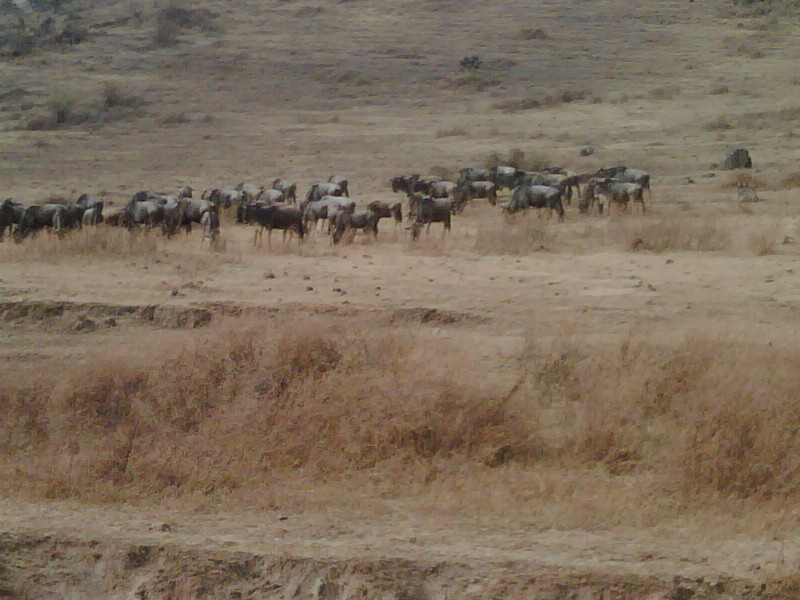
The most numerous big animals in the crater are Blue Wildebeests and Burchell's Zebra. Today I saw about 150 zebra and 10 times as many wildebeests. Included are some photos I took today of zebra and wildebeests. With so many prey around it is not surprising that there are predators. We did see one pride of lions just finishing a zebra. They were pretty far off in tall dry grass, if you look carefully you may see 2 or 3 lions in the last photo.

Wednesday, September 8, 2010

Africa Day 3

Today was the first full day in Tanzania. We spent the morning walking through a conservation area adjacent to our lodge at Gibbs farm. The lodge was quite beautiful, each unit is surrounded by native flowering plants along a hill side. Our trail was clearly popular with wildlife. It showed signs (scat) that elephants, buffalo, and baboons had been on the trail last night. But we only saw a baboon while on the trail. The highland (about 5000 ft) forest had a modest assortment of birds, but because it was cloudy bird numbers seemed low (our guide says the birds are more active when its sunny).
After lunch we drove to Ngorongoro National Reserve. This park protects the extinct Ngorongoro crater, from the rim one looks down at a flat plain that has a large lake, mostly grassland, and a small forest all within the 12 mile diamater crater. From the rim I could see wildebeest herds, a small group of buffalo, and numerous elephants! Tomorrow we will spend the day in the crater hopefully getting close views of the mammals, and of course birds.
So far I have seen about 130 species of birds and 15 species of mammals.
Included in this post are several photos of plants at Gibbs Farm, a tree rubbed smooth by elephants, and some shots of Ngorongoro crater. The strong haze washout the details of the crater.

Tuesday, September 7, 2010

Africa Day 2

Up early at 5:30 for the long drive to Gibbs Farm in Tanzania, west of Arusha. Due to extensive road work we often were diverted onto miles of dusty, rutted, slow going gravel tracks. Thus our hoped for 8 hour drive took 11 hrs!
But all was not lost we made 4 stops for birding and were pretty successful at birding from the van. Altogether we saw 57 species of birds, 35 we had not seen the previous day. Mammals were more limited, we saw giraffe and baboon again, as well as Blue Monkey. But mostly we saw many small herds of goats, donkeys, and cattle moving about under the watchful eyes of masai boys (all in traditional colorful wraps of flowing clothe). The land we drove through was very dry and according to our Tanzananian driver, Tanzania has been sufferring from a 4 month drought. It seemed hard to believe the land could support even 10% as much livestock.
Everywhere we went the Masai children gave us big smiles and waved as we drove by, so we did the same.
We finished the day with dinner at Gibbs farm a 70 year coffee farm, which operates as a tourist lodge, with many huge individual lodges and serves and excellent dinner.
Along the way I've seen many iconic Baobab and Acacia trees, as well as many huge termite mounds, I should be getting good pictures later on the tour.
Tomorrow we will do morning forest birding on the Gibbs farm land, our first birding away from the scrub and grassland habitats. After lunch we will head down to Norogondo crater.

Monday, September 6, 2010

Africa Day 1

Before attempting to climb Mt. Kilimanjaro, I will be on a 18 day birding and wildlife safari through Kenya and Tanzania. After sleeping in to recover a bit from the flights, I joined my tour group (5 other folks plus our Field Guides Tour leader, Terry Stevenson). We did a half day birding at Nairobi National Park, a mostly grasslands park, with some acacia scrub as well (see photo of the park). We saw 70 species of birds and 8 mammals! Among the mammals were giraffe, zebra, eland, gazelle, hartebeest and warthog.

Friday, September 3, 2010

Gearing up

This week I completed "gearing up" for the climb. I've surely made LLBean and REI very happy.

I need to be prepared for hot humid rain forest to start, and extreme cold at the summit. I purchased a new sleeping bag (good to zero F), camp pillow, sky pants, balaclava, two layers of thermal underwear, light weight long sleeve shirts, safari sun hat, fast drying Safari pants (jeans are discouraged because they don't dry well if wet), rapid dry camp towel, duffel bags, trekking poles, and water proof pack covers. I have also bought insulated water bottles (needed to prevent drinking water from freezing on the day I will try to reach the summit), water purification tabs, isotonic salt hydration mixes, high energy trail bars, headlamp for the summit attempt which starts at 1:00 AM), extra camera and blackberry batteries.

I will carry a day pack with up to 20 pounds, including the days water, energy bars, dried fruit, anticipated clothes/rain gear, electronics, binoculars, bird book, and my first aid kit. Along with 4 hiking companions, my climbing group will include a guide, a cook, and porters. A porter will carry my duffel bag with 30 pounds of my gear I don't carry.